
Deck Repair vs Deck Replacement: How to Make the Right Call for Your Home
If your deck is showing signs of wear, you are probably asking yourself the same question most Vancouver homeowners eventually face: is it worth fixing, or is it time to start fresh? The answer is rarely obvious at first glance, and making the wrong call in either direction can cost you significantly more than necessary.
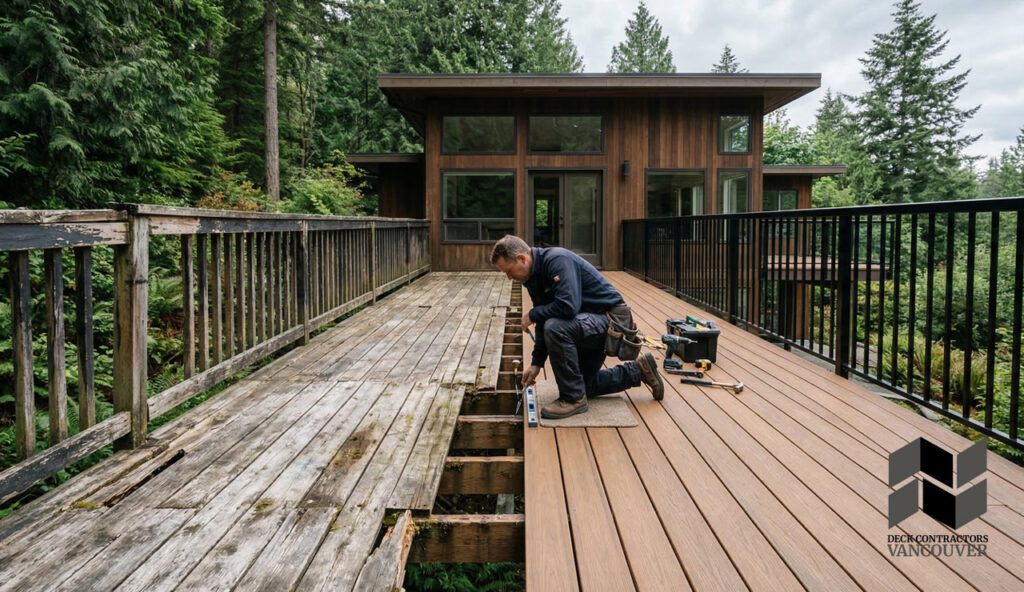
In this guide, we walk through the key differences between deck repair and deck replacement, what to look for when assessing your deck, what each option realistically costs in the Vancouver area, and how to make a decision you can feel confident about.
Why this decision matters more than you think?
When a deck starts showing signs of wear, the instinct is often to act fast, patch it up or tear it down and start fresh. But rushing that decision without a clear understanding of what you’re actually dealing with can lead to spending far more than necessary. A repair that doesn’t address the root cause will fail again, and a full replacement that wasn’t needed is simply money left on the table.
Not all deck damage looks the same beneath the surface. A few warped boards or a faded finish might be purely cosmetic, while a deck that looks decent from the outside could have serious rot in the joists or a compromised ledger board connection. That gap between what you see and what’s actually going on structurally is exactly why a proper assessment matters before any work begins.
In Vancouver and the surrounding area, the climate adds another layer of urgency to this decision. The persistent moisture, heavy rainfall, and mild but damp winters create conditions where wood deteriorates faster than in drier parts of the country. What might be a manageable repair in a drier climate can quietly become a structural problem here if left unattended. Beyond safety, the condition of your deck directly affects your home’s curb appeal and resale value, making this a decision worth getting right.
Clear signs that deck repair is the right move
Repair makes the most sense when the damage is contained and the rest of the deck is in good shape. If you are dealing with one or two boards that have cracked, cupped, or started to splinter, replacing just those boards is a straightforward and cost-effective fix. The same applies to a single railing section that has come loose or a stair tread that has seen better days. Isolated problems do not require a full overhaul.
The condition of your deck’s frame and structural posts is the most important factor in this decision. If the joists, beams, and posts are still firm, properly connected, and free of rot, the foundation of your deck is sound. In that case, addressing surface-level issues through targeted repairs will extend the life of your deck by many years without the cost and disruption of a full replacement.
Age also plays a significant role. A deck that is under ten years old and was properly built and maintained has a lot of useful life ahead of it. Minor cosmetic issues like a faded or weathered finish, light surface splintering, or boards that have lost their colour are completely normal at this stage and do not indicate failure. A good cleaning, sanding, and a fresh coat of stain or sealant can restore the appearance and protection of a structurally sound deck at a fraction of the cost of replacing it.
When deck replacement makes more sense
There are situations where repairs simply delay the inevitable. When the problems go beyond the surface and affect the integrity of the structure itself, replacement is not just the better option — it is the responsible one. Understanding what to look for helps you make that call with confidence.
Wood rot and insect damage
The simplest way to check for rot is the screwdriver test. Press the tip of a screwdriver firmly into any wood that looks discoloured, soft, or spongy. If it sinks in more than a quarter inch with little resistance, the wood has rotted through and needs to go. Pay close attention to areas that stay damp the longest, such as boards near the house, around post bases, and anywhere water tends to pool.
Finding rot in one spot is rarely good news for the rest of the deck. Moisture moves through wood over time, and by the time rot is visible on the surface, it has often already spread to the joists, beams, or ledger board below. The same logic applies to insect damage. Termites and carpenter ants tend to work from the inside out, so visible tunnelling or hollow-sounding wood in the substructure is a strong signal that the damage runs deeper than what you can see.
Structural and safety concerns
A deck that feels bouncy underfoot, shows visible sagging, or sits unevenly is telling you something important about what is happening below the surface. These are not cosmetic issues. They point to problems with the joists, posts, or footings that no amount of surface repair will fix. A deck in this condition is a safety risk and should be assessed by a professional as soon as possible.
The connection between the deck and the house, known as the ledger board, is one of the most critical points in the entire structure. A loose, rotted, or improperly flashed ledger board is one of the leading causes of deck collapses. If posts are leaning, footings are cracking or heaving due to ground movement, or the deck was built without a permit and does not meet current building code, replacement is almost always the right path forward.
Age and overall condition
The material your deck is made from largely determines how long it should last. Pressure-treated wood typically holds up for 20 to 30 years with proper maintenance, while cedar and redwood average around 15 to 25 years. Composite and PVC decking, on the other hand, is designed to last 25 to 50 years. If your deck is approaching or past those thresholds, replacement is worth serious consideration even if no single issue stands out.
A useful rule of thumb is the 50% rule. If the cost of repairs adds up to more than half the cost of a full replacement, you are better off replacing the entire deck. At that point, you are investing heavily in an aging structure rather than starting fresh with modern materials and a clean slate. This is especially true if the existing design feels dated or no longer complements the look of your home after a renovation.
| Criteria | Deck repair | Deck replacement |
|---|---|---|
| Typical cost range | $100 – $2,500 | $3,200 – $15,000+ |
| Time to complete | 1 hour – 2 days | 8 – 15 days |
| Best for | Isolated damage, cosmetic wear, decks under 10 years old | Widespread rot, structural failure, aging or unsafe decks |
| Structural integrity | Frame is sound | Frame is compromised |
| Rot or insect damage | Limited to 1–2 areas | Widespread or in substructure |
| Permit required | Usually not required | Almost always required |
| Disruption to home | Minimal | Moderate to high |
| Material upgrade opportunity | Limited | Full — composite, PVC, cedar |
| Design upgrade opportunity | Not applicable | Full redesign possible |
| Impact on home value | Maintains current value | Can increase resale value |
| Lifespan after work | 3 – 10 additional years | 20 – 50 years (material dependent) |
| Vancouver climate suitability | Short-term fix if moisture is ongoing | Best long-term solution in wet climates |
| When to choose this option | Repair cost is less than 50% of replacement cost | Repair cost exceeds 50% of full replacement cost |
| Deck Contractors Vancouver | Not sure which option fits your situation? A professional inspection is the best first step. | |
Deck repair vs deck replacement costs: a practical comparison
For most common repairs, costs are relatively manageable. Replacing a few damaged boards typically runs between $100 and $500, while fixing a wobbly railing or reinforcing stair stringers usually falls in the $50 to $300 range. Refreshing a weathered wood finish sits around $100 to $300 depending on deck size. These are straightforward jobs that a qualified contractor can complete in a day or less, without disrupting your home or requiring a permit.
Full deck replacement is a significantly larger investment. In the Vancouver area, rebuilding a mid-size deck of around 300 square feet with railing can range from $8,000 to $20,000 or more depending on materials and site conditions. Composite and PVC decking sit at the higher end of that range, while pressure-treated wood comes in lower upfront. That said, the gap narrows considerably when you factor in the long-term maintenance costs that come with wood over time.
What catches many homeowners off guard are the costs that sit outside the main build. Demolition and disposal of an old deck can add $300 to $700, building permits in the Vancouver area typically run $150 to $800 depending on the scope of work, and new concrete footings can add another $500 to $1,500 if the existing ones need to be replaced. Choosing a durable, low-maintenance material like composite from the start reduces the likelihood of repairs down the road and often delivers better long-term value despite the higher upfront cost.
| Item | Estimated cost (CAD) | Time to complete | Permit needed |
|---|---|---|---|
| Common deck repairs | |||
| Replace 1–3 damaged boards | $100 – $500 | 2 – 4 hours | No |
| Fix loose or damaged railing | $50 – $300 | 1 – 3 hours | No |
| Replace broken baluster | $20 – $75 | 1 – 2 hours | No |
| Reinforce bouncy stairs | $85 – $200 | 2 – 4 hours | No |
| Refinish weathered wood surface | $100 – $400 | 1 – 2 days | No |
| Replace multiple joists | $500 – $1,500 | 1 – 2 days | Sometimes |
| Full deck replacement (300 sq ft with railing — Vancouver area) | |||
| Demolition and disposal | $300 – $700 | 1 – 2 days | No |
| Building permit | $150 – $800 | 1 – 3 weeks | Yes |
| New concrete footings | $500 – $1,500 | 1 – 2 days | Yes |
| Framing and structural hardware | $1,200 – $2,200 | 2 – 4 days | Yes |
| New decking — pressure-treated wood | $900 – $1,800 | 2 – 3 days | Yes |
| New decking — cedar | $1,200 – $2,800 | 2 – 3 days | Yes |
| New decking — composite or PVC | $1,800 – $4,500 | 2 – 3 days | Yes |
| New railing — wood (50 linear ft) | $900 – $1,800 | 2 – 3 days | Yes |
| New railing — composite or aluminum | $2,500 – $5,500 | 2 – 3 days | Yes |
| Estimated total project cost | |||
| Typical repair (minor to moderate) | $100 – $2,500 | 1 hour – 2 days | Rarely |
| Full replacement with wood railing | $8,000 – $13,000 | 8 – 15 days | Always |
| Full replacement with composite and aluminum railing | $13,000 – $20,000+ | 10 – 18 days | Always |
| Deck Contractors Vancouver | Prices are estimates for the Vancouver area and may vary based on site conditions, materials, and project scope. Contact us for a free quote. | ||
How to choose the best option for your situation?
Before calling a contractor, it helps to do a quick honest assessment of your own deck. Ask yourself how old it is, whether the damage is limited to one area or spread across the structure, and whether you have noticed any soft spots, bouncing, or movement underfoot. If you are unsure about the answers, that uncertainty itself is a good reason to bring in a professional.
A qualified deck contractor in Vancouver will inspect the frame, joists, ledger board, posts, and footings, giving you a clear picture of what you are actually dealing with before any money is committed.
Not every situation calls for a full repair or a full replacement. In many cases, a partial replacement is the smartest middle ground. Replacing only the decking boards while keeping a sound frame, or upgrading the railing system without touching the rest of the structure, can significantly extend the life of your deck at a fraction of the cost of starting over. At Deck Contractors Vancouver, we work through exactly this kind of assessment with every homeowner we meet, so you can make a confident, informed decision rather than an expensive guess.